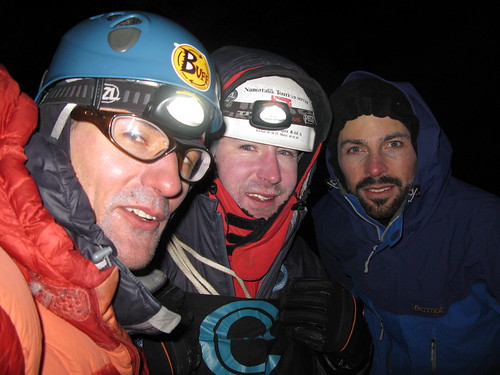
This article has just been published in Summit Magazine:
The Alpine Club Antarctica Expedition 2010
The boat lurched and I felt my bunk kick violently. Now I was flying… I grimaced into a ceiling that was a couple of inches above my nose: What was I doing here? Would I never learn? For sure this was the last time I was ever, ever going sailing. I was trying to sleep and my super-uncomfortable bunk with no headroom up in the forepeak of the vessel meant I was getting airtime on every wave. And seasickness as well. They say that the first stage of seasickness is thinking that you are going to die. The second stage is wishing you actually were dead. I was getting near to the second stage.
Since 2005 I’d been on what was starting to feel like a never-ending, post-modern version of The Oddessey. The aim of the journey was to visit every one of the 7 continents and to attempt to make a first ascent. So far; North America, South America, Asia, Australasia and Europe had given us some interesting adventures. As I was planning the Antarctica stage I heard that Phil Wickens was organsing The Alpine Club Antarctica Expedition 2010 and he gave me a place on the trip along with climbing veterans Richmond McIntyre, Derek Buckle, Mike Fletcher, Dave Wynne Jones and Stuart Gallagher.
I had mixed feelings about this trip… The mountains were not high; but the trip had all the factors that can make expedition climbing a bit demanding at times: Remote and challenging unclimbed mountains. Hazardous small boat navigation in waters strewn with icebergs and growlers… Oh yeah; did I mention the other things that were going to make this trip a bit special? We would be climbing in a place where the only option was self-rescue if things went wrong. And to get there; we would have to cross; (in a tiny sailing boat and via Cape Horn!) The Southern Ocean’s infamous Drake Passage; generally acknowledged to be the roughest ocean in the planet.
The Drake Passage; in The Southern Ocean is rite of passage for anyone heading by boat to The Antarctic. Also known as ‘Paying The Drake Tax’ or ‘The Climber Filter.’ According to The Antarctic Cruising Guide by Peter Carey and Craig Franklin it is the narrowest portion of the easterly flowing Antarctic Circumpolar Current, the only place where it is squeezed between land masses. When forcing itself through the bottleneck the current moves 130million cubic meteres of or 170 million cubic yards of water per second.
We’d teamed up with two expert ice skippers: Darrel Day and Cath Hew. It was their dream to run a Tilman-style expedition to Antarctica and they were passionately enthusiastic about teaming up with us and gave us a really great deal on the yacht charter. They had been sailing their yacht; ‘The Spirit of Sydney’ in these hazardous waters since 2003 and they were both the key to making this expedition happen.
Not only did we have two expert ice skippers; but the boat ‘The Spirit of Sydney’ was also a noted vessel. Built of aluminium on heavy scantlings in 1986 The 60 ft long Spirit of Sydney was constructed in an era when the need for lightness was tempered by respect for the ocean. Her features included central heating; a drying area; a water-maker; a shower; submarine doors that separated 10 watertight sections and also a water-maker.
Crossing the Drake takes about 4 days on a fast yacht like Spirit. Somewhere in the middle of The Drake Passage crossing is the polar front of Antarctic convergence. This is an oceanographic feature that makes the boundary between the Subartarctic water on the north and colder Antarctic waters from the south. The Drake is also a paradise for seabirds and a place to look for pairs of albatrosses with wingspans up to 9 feet who glided effortlessly in our wake.
We didn’t land for days. The sea was angry for most of the time and squadrons of mountainous waves were marched relentlessly towards us. Every single time we hit a wave ie every 30 seconds; the snout (where four of us were sleeping forward of the mast in the forepeak) of the over-loaded boat (she’s about 9 tons overwieght reckoned our Skipper Darryl Day with her payload of 1400L of Diesel; 52 bottles of red wine; and a blush-inducing quantity of beer) would slam violently into the towering waves. Most of the front half of the boat would bury itself face first into the wave. Then a couple of hundred gallons of water would break over the bows. Over our skylight in the cabin it was about a few inches thick; and despite the fact it was meant to be watertight; a few drips of water would always scatter their way into our cabin and sleeping area.
With tons of white water smothering her bows the yacht would pause for a: Will she? Won’t she? moment… When she did. Eventually. Rise; with water streaming from the gunnells ; the load on the powerful sails would combine with the hull being further out of the water. Cue viscously uncomfortable sideways twist of the the entire fuselage of the boat And anyone on board who had forgotten the sailor’s rule of ‘A hand for the boat and a hand for yourself’ would be hurled across the cabin with a malevolent and often painfull force. The Drake Passage was an experience that went on and on with the grim relentlessness of the last guest at the party.
On the hill the character building experiences continued. I was sharing a tent with Richmond McIntyre and our wilderness camping skills on snow had ‘room’ for improvement. I well remembered how much hard work it was the last time I’d camped on a glacier. That was at our base camp in The Ruth Gorge for the Alaska stage of Super7 with James Mehigan in The Ruth Gorge. To combine with all the usual hard graft of living in a tiny tent you have all the challenges of melting snow. I remember me and James talking about how just surviving seemed to take up most of our days. And back then we had unlimited supplies of food and gas and a big comfy tent and a snow-hole mansion that we’d inherited from a mountain guide.
Now we were living on 1400 calories per day; with a borrowed stove that we couldn’t make work correctly; and snow camping skills that were basic at best. The others were all super-experienced ski tourers and they had all the gear and all the techniques for the black art of snow camping wired. The low point was when I was attempting to get the stove to melt water and I spilled an entire pan; 2.5litres of water into the tent.
On our first day we used a cannister of gas and it was supposed to last until day 2. We took emergency measures: cold food only and no hot drinks. It was day 5 until we were back on track and we could enjoy our first hot drink. Not good. The weather spooked me out as well. It seemed to follow no set pattern at all. It was either completely still with not a breath of wind… The silence seemed eerie at times. Then; seemingly out of nowhere; the wind would blow up and if you took your gloves off then frost injuries were just a few seconds away. The weather seemed to deteriorate in minutes with no warning. It often felt like we might be on the verge of a malevolent, tent-flattening storm. Otherwise the wind alternated between 20 minutes of wind which would build up to a howling crescendo and then stop; and there would then be 20 minutes of silence before the cycle began again.
The climbing was different to anything I’d ever climbed before; and I realised that even if you are a fairly competent mixed climber; it counts for almost nothing when you are attempting to summit on big, scary, snowy mountains. All the routes that I had climbed before had been technical routes on faces or ridges and often the gear was excellent. All this mixed climbing had left a huge blank gaping hole in my climbing CV and it’s name was ski mountaineering.
No one had been this much out of their depth since Captain Nemo got his foot stuck in a submarine. Why was I here? It was grim but every time I thought out about throwing in the towel the words of Margaret Thatcher would ring in my ears. ‘It’s easy to start things. But are you a finisher?’ And then Lance Armstrong would chime in. ‘Pain is temporory. Failuire is permanent.’ There was also the small matter of the eye-watering cost of going to Antarctica on a private expedition. I wasn’t sure I could afford a repeat trip down here.
By day 4 the entire team apart from me had made a successful ascent of Nygren; Back in basecamp after bailing on False Shackleton with Stu and Dave while Derek, Mike, Phil and Rich made the first ascent I was learning all about the bitter taste of humble pie in my tent. Except without any pie to eat. At one point I was so hungry that I raided the bin, opened the foil wrappers for the compo rations and licked them clean. I also supplemented our basic rations by sucking clean the porridge scourer.
Just when I thought things couldn’t get any worse the news came over the radio from Darrel that Deloncle bay; where we had been dropped off; was now ice choked. In other words. We were up the creek. Without a paddle. Or a canoe. The next day as the rest of the team summitted on Matin I stayed at base camp with Stu; feeling emotionally, physically and mentally drained. At 35 I was the youngest on this trip by half a decade. Phil and Mike were in their 40s and most of the rest of the team were expedition veterans in their 60s. ‘It was just like this on McKinley’ said 7 summitteer Rich. ‘It is always the youngest who fail first…
I was reading a book by Sir Ernest Shackleton. ‘In trouble, danger and disappointment never give up hope. The worst can always be got over.’ His words were ringing in my ears as I looked at our remaining supplies of food and gas. We’d put in a lot of hard work to rein in our food consumption by not eating very much food (breakfast was 200g of porridge; lunch was four 67calorie cereal bars and the less that is said about dinner the better). We’d also worked hard to use solar sills for water. Now we had a decent amount of food and gas left and we could start to ‘buy forward’ as Rich put it.
I wrote in my diary. ‘Tomorrow I will climb Mt Cloos’; and for the first time in 6 days I had a decent nights sleep. Tomorrow came and went; stormbound in in the tent. But the next day it seemed like we had a weather window. I started to eat more maybe 2500 calories. The food put fire in my veins and molten fuel in my belly. I felt light, strong, and stoked for climbing again.
In ‘Shackleton’s Way’ by Margot Morrell and Stephanie Capparrell they write about how Antarctica looms large in the western psyche. ‘It is the symbol of the unattainable dream, of absolute isolation, of man’s hardest battle against nature and of the ultimate test of a persons mental and physical capabilities. It represents the kind of test that if you survive it at all, it is by the skin of your teeth and you emerge a better person for it’. The continent is so uniquely beautiful. Anyone who has been to ‘The Ice’, as it is called, speaks of its majesty, the profound quiet, and of the extraordinary colours hidden in its simple blue and white silence.’
Australian explorer Louis C Bernacci, the physicist on Scotts discovery expedition wrote; ‘At times veils of ice crystals thinly veiled the sun as in a glittering tenuous garment, reflecting its rays so that the whole arch of the heavens was traced with circles and lines of brilliant prismatic or white light.’
And it was so very, very beautiful. We might be currently trapped here; but tomorrow is a day when I know I will climb hard and climb well. The day began; and it was one of those days when it all feels right and it just comes together. By midday we have climbed an unclimbed summit. Me, Phil, Rich, Derek and Mike on the sub summit of Mt Cloos that is called Cape Cloos. From below it looked like it might be the highest point. ‘There’s only one problem with this’ says Derek as we sat on the summit. ‘It ain’t the highest point.’
There is however an unfortunate ‘Houston we have a problem’ kind of an issue with the highest point – The large seracs that shield the first pitch of the route. Rich decided to go back to base camp at this point and it was just myself; Phil Wicken; Derek Buckle and Mike Fletcher who were up for the route. It was such a beautiful mountain; a real climber’s mountain; steep; shaped like a spinx and flanked with rock buttresses and seracs I really wanted to climb Mt Cloos. Underneath the seracs I am scared by their ominous silence. The climbing is going well today; we’re pioneering the first ascent of this beautiful mountain on good ice. The wind is howling but after the scary serac-threatened first pitch and now with those Damoclean seacs below us it feels like gravity will lessen her force for us today. The wind is strong, the temperatures are around -25 degrees with the wind chill; and we’re cold; but we’re having a day that will be burned into our memories forever in these remote mountains. It’s something I’ve always known…. I love it; I just love it.
Pitch 2 takes us across the face. Pitch 3 features some spicy vertical ice, then a difficult move to pull from the vertical ice onto the summit snow slopes with a good screw below and then we are on the summit slopes. As we summit the mountain a white Petrel shares this remote place with us. ‘Hopefully a good omen for the descent’ says Mike. We’re tired we have been on the go for nearly 12 hours; and we talk about the need to keep a laser like focus on a safe descent.
We all agree that the key to getting down is to simply down-climb pitch 3 and pitch 2 because the traverse above the seracs means that it makes no sense to abseil. Derek goes first; then Phil on a hastily arranged snow stake belay that I’m equalising as Mike pays out the rope. Then Mike leaves me to down-climb the route crux and I’m keeping him on a tight rope and and I’m all so alone on the summit slopes with what feels like a final exam in mountaineering below me.
There are various options to protect me on down-climbing the crux of the route which went at about Scottish V. I could place a back-rope or get Mike to place some extra gear below the crux. It feels like the best option is to keep things very simple; be bold; and just reverse the crux moves I struggled to climb about an hour ago. I know that I won’t be able to communicate with Mike because of the sound of the wind and I calculate that there is far more chance of me having issues with a back-rope when out of communication with my partner than there is of me falling off. ‘You can do this’, I tell myself.
I’ve asked the rest of the team to jack-boot the crux of the route (the place where the ice goes from steep summit slopes to verticalish) into submission; which they have done to fine effect and I try to keep my mental state as icy cool as the wind that howls around us with chilling frigidity (even tho’ in reality I am actually scared stupid). Now I have have down-climbed the crux and I’m back on the traverse; as the wind howls like a squadron of 747’s and the bitter cold snarls my layers of clothing like a wild animal.
Derek has already set up an abseil for the ice pitch under the seracs now and now there is a call over the radio. It is 8pm and we are still on the mountain. It’s Stu Gallagher. ‘Everthing ok up there?’ he says in a voice that sounds worried ‘You’ve been a while’. Derek’s response was short and simple. ‘It’s hard.’ We rap the final pitch. I faff coiling the ropes and then we’re skiing down; just cruising on the ski’s; over the gentle slopes down to our camp and it feels good. Back in the tent I get a plate of hot food from Rich and I collapse into my sleeping bag.
We’re still out on a limb. The Lemaire Channel is ice-choked. We may have to wait on the shore and make Shackleton-style improvisations until we can get out of here; but we have climbed the route; and it feels so good. In the morning we get more info on ice conditions in the Lemaire Channel from Darrel over the radio. The words that I hear make my heart go on an express-elevator into my shoes. We might not be able to get picked up today. In the words of Shackleton; it is time to ‘Put foot of hope into stirrup of patience.’
I’ve had enough. I feel mentally, emotionally, and physically drained. The only contingency we have in place for this situation is an emergency barrell full of basic food and some more gas cylinders that are sat on top of an fragile ice cliff on the shore that might or might not still be there. Me and Rich have one full cylinder of gas left and about 4 days left on half rations. Not good.
I force myself to think of the bright side of the situation. None of us are injured. We still have radio and Iridium contact with the yacht. We can make liquid using solar stills. The food barrel and the spare gas will probably still be there. Stu can fish. In extremis; We might be able to kill some penguins or seals if we really get hungry. It is early December; spring the ice conditions will probably get better rather than worse. There is also a potential escape route over the back of False Shackleton.
And like Phil says; Ice conditions change every day. And anyway; there is the potential of us moving out of Deloncle bay for a pick up somewhere else on The Lemaire. Maybe it will be okay… I look at the landscape around me. It was so hauntingly beautiful; and quiet…. Maybe this was where the real adventure began?
I followed the team to the sea; moving or perhaps I should say mincing slowly on blistered feet. They had flown ahead of me on their long ski’s and I was struggling down on short ski’s that were attached to my Vega’s. As we descended The Lemaire channel became increasingly visible and about half a km away from The Lemaire channel things were not looking good. It was choked with ice and I mentally prepared myself for whatever was to come.
I stood up straight and resolved to keep forging on; and just enjoy every moment of whatever was to come… That was how Shackleton styled it… ‘To be brave cheerily, to be patient with a glad heart, to stand the agonies of thirst with laughter and song, to walk beside death for months and never be sad that’s the spirit that makes courage worth having.’ he wrote after Elephant Island.
As I descended to glacier The Lemaire was getting closer. And with it a hot sun and a dry mouth. The rest of the team were tearing ahead on their long ski’s. I’d been climbing for 18 hours yesterday and I hadn’t drunk enough water. I rounded the corner and had to do a double-take. Like a mirage in a desert of ice; The beautiful yacht with her flared bowsprit and low; clean lines was moored in the bay; tugging at her anchor and looking like an ocean-going Maserati. She was tugging at her anchor; an ocean greyhound; eager to race across the high seas once again. There was an awful lot of white ice surrounding her but she wasn’t choked in by it. Spirit of Sydney was there; sitting proud. I blinked tears out of my eyes and manfully, I refrained from blowing her a kiss. Soon we would be back on the boat.
Thanks to The Gino Watkins Memorial Fund, The Alpine Club, The Lyon Equipment Award, The Mountaineering Council of Scotland, The Spirit of Sydney, Buff, Montane, Chromefire, Crux, Creation Editor, Primus and The Business for supporting this expedition.

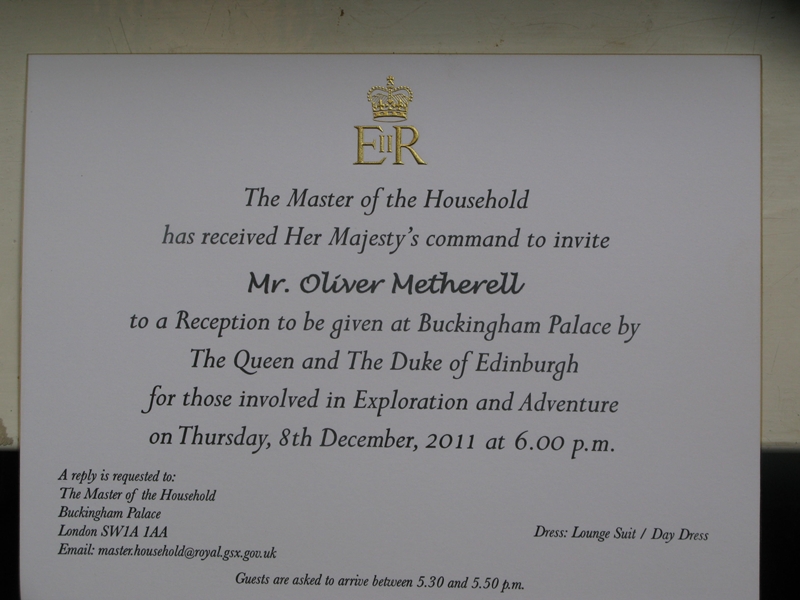 I’ve been invited to Buckingham Palace to a reception given by The Queen and The Duke of Edinburgh. The reception is on the 8th December and it is being given for those involved in exploration. It commemorates the 100th Anniversary of Scott’s expedition to The South Pole.